
Skincare for combination skin sounds like it should be complicated, but after eight years of testing products on my own combination skin, I can tell you the truth is far simpler than the beauty aisle wants you to believe. If your forehead and nose turn shiny by lunchtime while your cheeks feel tight and flaky, you have the classic pattern, and you have probably been sold two routines when you only ever needed one.
I am Sara Mitchell, Beauty and Wellness Editor at MyBreezyLife, and I write this as someone with a BSc in Cosmetic Science from the London College of Fashion, UAL. My own skin is medium-olive, combination, and prone to hyperpigmentation, so this is not theory for me. It is the routine I actually run.
What combination skin actually is
Combination skin means different zones of your face behave differently. The T-zone (forehead, nose and chin) produces more sebum and looks oily, while the cheeks, and sometimes the area around the eyes and jaw, sit on the drier, tighter end. Most UK women I speak to assume this means their skin is fighting itself. It usually is not.
Here is the part nobody tells you. Over-stripping the oily zone with harsh cleansers and strong acids is one of the most common reasons the cheeks end up dry and irritated. The two problems are frequently the same problem wearing two costumes. Calm the whole face down, support the skin barrier, and the contrast between zones often softens on its own.
That single insight changes how you shop. Instead of buying a mattifying range for your T-zone and a rich range for your cheeks, you build one gentle, balanced core routine and make small, targeted tweaks.
How to know if you have combination skin
The quickest way to know if you have combination skin is the bare-face test, and it takes about an hour. Cleanse with a gentle wash, pat dry, then leave your skin completely bare with no serum, moisturiser or SPF. After 60 minutes, look closely in good daylight.
If your forehead, nose and chin look shiny or feel slick while your cheeks feel tight, dry or slightly flaky, that split is the signature of combination skin. Purely oily skin tends to look shiny all over, and dry skin feels tight everywhere with no oily zone at all.
A few other tells I look for: makeup or SPF that slides off the T-zone by midday but clings and looks patchy on the cheeks, pores that are larger down the centre of the face and almost invisible on the outer cheeks, and the odd spot on the chin sitting next to dry patches near the jaw. Skin also shifts with the seasons, so you might notice a stronger oily zone in a humid British summer and drier cheeks once the central heating comes on in autumn.
Why most skincare for combination skin fails
Most routines marketed at combination skin fail for one of three reasons, and I see all three constantly.
The first is over-cleansing. Foaming face washes that leave skin squeaky tight strip the protective lipids your barrier needs, which triggers more oil in the T-zone and more flaking on the cheeks. The second is layering too many active ingredients at once. Retinol, vitamin C, an exfoliating acid and a clay mask in the same week is a fast route to a compromised barrier. The third is skipping moisturiser because skin feels oily, which only pushes oil production higher.
A balanced routine does the opposite of all three. It cleanses gently, treats with one or two well-chosen actives, hydrates lightly, and protects with SPF every single morning.
Skincare for combination skin: the routine that actually works
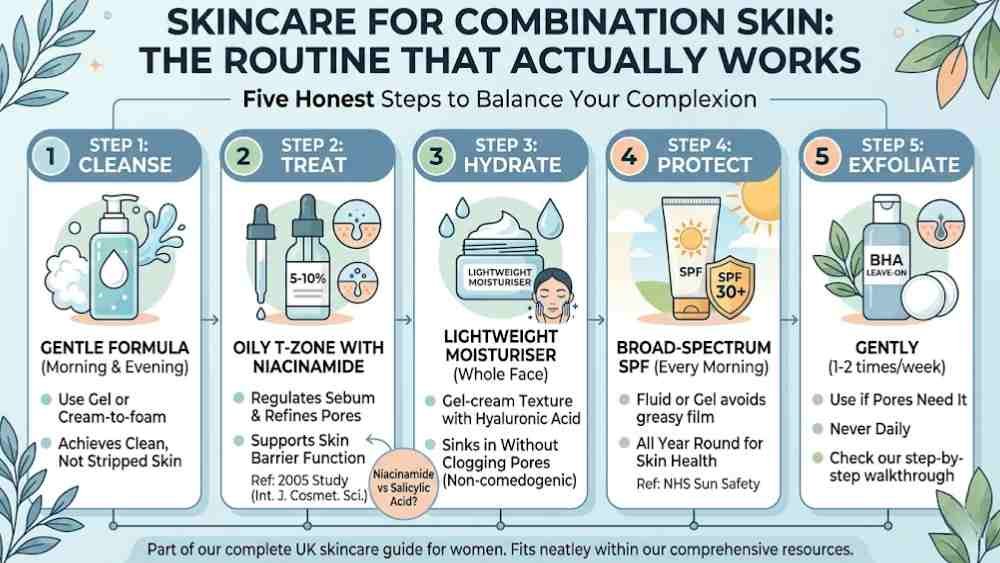
Good skincare for combination skin comes down to five honest steps, not fifteen. Here is the structure I have used and recommended for years, and it fits neatly within our complete UK skincare guide for women.
Cleanse with a gentle gel or cream-to-foam formula, morning and evening. You want clean skin, not stripped skin.
Treat the oily zone with niacinamide. At 5 to 10 percent, niacinamide helps regulate sebum, refines the look of pores and supports the barrier. According to a 2005 study published in the International Journal of Cosmetic Science, topical niacinamide measurably improved skin barrier function and reduced water loss, which is exactly what combination skin needs. If you are weighing up actives, my piece on niacinamide versus salicylic acid breaks down which to reach for and when.
Hydrate with a lightweight, non-comedogenic moisturiser across the whole face. Gel-cream textures with hyaluronic acid sink in without sitting heavy on the T-zone. If you are not sure whether your current cream is the problem, the signs your moisturiser is clogging your pores are worth knowing.
Protect with a broad-spectrum SPF 30 or higher every morning, all year round. A fluid or gel SPF avoids the greasy film that makes oily zones worse. The NHS is clear that daily sun protection matters for skin health, not just on holiday (NHS sunscreen and sun safety).
Exfoliate gently once or twice a week with a leave-on BHA if your pores need it, never daily. For a full ordered walkthrough, see our step-by-step Best Skincare Routine for Combination Skin.
My honest results after testing
I ran this exact five-step approach for six weeks through a Birmingham winter, when central heating usually leaves my cheeks flaking by February. By week three the tightness across my cheeks had eased, and my T-zone was visibly less shiny by mid-afternoon. I had expected the niacinamide to help the oil. What surprised me was how much calmer my dry patches became once I stopped over-cleansing.
The other thing I noticed, and yes, it does sound too simple, is that swapping a foaming cleanser for a gentler one did more for my skin than any single serum I tried that year.
UK product recommendations
These are products I genuinely rate for combination skin, all available in the UK with current prices. The thread running through them is balance: each one targets the oily T-zone without leaving the drier areas tight.
Gentle daily cleanser
CeraVe Foaming Cleanser | £13.00 | Buy on Amazon
This gel cleanser foams enough to lift excess oil and sunscreen off the T-zone, yet it is built around three ceramides and niacinamide, so it cleans without dismantling the barrier on your cheeks. That balance is what makes it suit combination skin rather than purely oily skin. I have used it most mornings for the past two years and my cheeks have never felt stripped afterwards.
Oil-regulating serum
The Ordinary Niacinamide 10% + Zinc 1% | £5.00 | Buy on Amazon
Niacinamide calms sebum in the oily zone while supporting hydration in the drier areas, which is why one serum can suit a face that behaves two different ways. The 1 percent zinc adds a light oil-control effect across the T-zone. At £5 it is the most cost-effective way to treat combination skin I know of.
Stronger gel cleanser for very oily T-zones
La Roche-Posay Effaclar Purifying Foaming Gel | £19.27 | Buy on Amazon
If your T-zone runs particularly oily, this purifying gel clears shine and congestion more firmly than a basic wash. I would keep it for combination skin that leans oily, and I use it in the evening only so the cheeks are not over-cleansed. Alternating it with a gentler morning cleanser keeps the drier areas comfortable.
Lightweight daily SPF
Altruist Sunscreen Fluid SPF 50 | £8.00 | Buy on Amazon
The fluid texture is the detail that matters: it gives high broad-spectrum protection without the heavy, occlusive feel that makes an oily T-zone worse by midday. It sinks in quickly, sits well under makeup, and leaves no white cast on medium or deeper skin tones. You can read my full Altruist SPF 50 review for the detail.
For a featherlight daily cream to finish the routine, my round-up of the best lightweight moisturiser for oily skin covers more options across budgets.
Halal and cruelty-free options
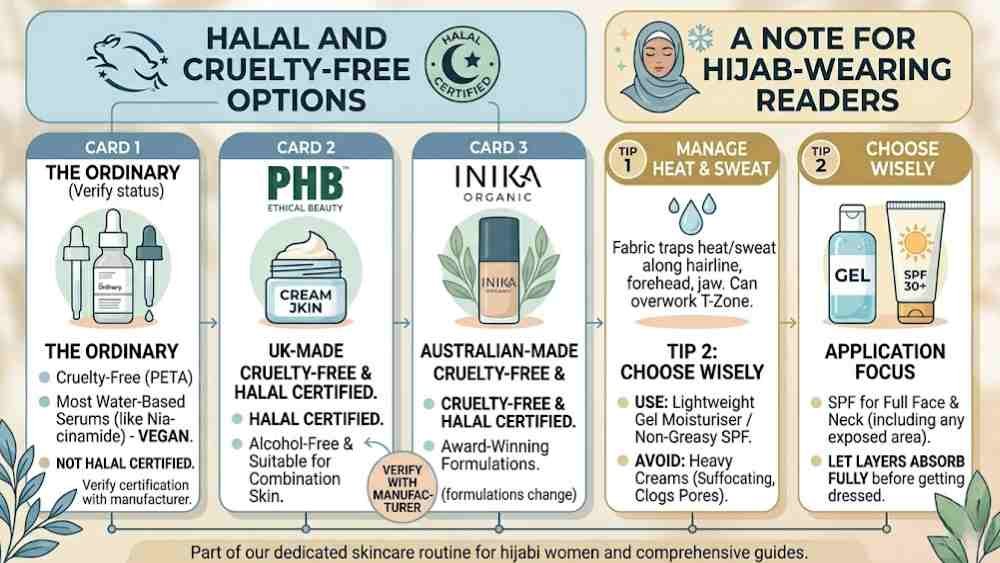
Halal status varies by brand, so always verify current certification directly with the manufacturer, as formulations change. The Ordinary is cruelty-free and most of its water-based serums, including the niacinamide, are free from animal-derived ingredients, though the brand is not halal certified. For readers who want certified options, PHB Ethical Beauty and INIKA Organic offer cruelty-free, alcohol-free formulas suited to combination skin and are widely stocked in the UK.
A note for hijab-wearing readers
For hijab-wearing women, the skin along the hairline, forehead and jaw can trap heat and sweat under fabric, which often makes the oily T-zone work harder. A lightweight gel moisturiser and a non-greasy SPF help here, because heavy creams under a hijab on a warm day can feel suffocating and clog pores. Focus your SPF on the full face and neck, including any area the hijab does not cover, and let each layer absorb fully before getting dressed. For more on this, see our dedicated skincare routine for hijabi women.
Your Combination Skin Questions, Answered
Is combination skin the same as oily skin?
No. Oily skin produces excess sebum across the whole face, while combination skin is oily only in the T-zone and normal to dry everywhere else. The bare-face test above is the quickest way to tell them apart.
What ingredients should I avoid if I have combination skin?
Harsh sulphate foaming agents, high levels of alcohol, and heavy occlusives such as mineral oil tend to tip the balance, either stripping the cheeks or congesting the T-zone. Daily gritty scrubs are the other common culprit.
How often should I exfoliate combination skin?
Once or twice a week is enough for most people. A leave-on BHA like salicylic acid suits the oily zone, and you can keep it off the drier cheeks if they feel sensitive.
Can I use a facial oil if I have combination skin?
Yes, but apply it only to the dry areas rather than all over. A light oil such as squalane on the cheeks can balance the skin without making the T-zone greasier.
Does combination skin change with the seasons?
Often, yes. Many UK women find the T-zone is oilier in a humid summer and the cheeks drier once central heating starts in autumn, so it is worth adjusting how rich your moisturiser is through the year.
The takeaway
Good skincare for combination skin is about balance, not battle: cleanse gently, treat lightly, hydrate everywhere and protect daily, and let your two zones meet in the middle.
Beauty & Wellness content at MyBreezyLife is created by our editorial team and reviewed by founder Noreen Fahad. Clinical claims are referenced. This article may contain affiliate links. We only recommend products we genuinely rate.