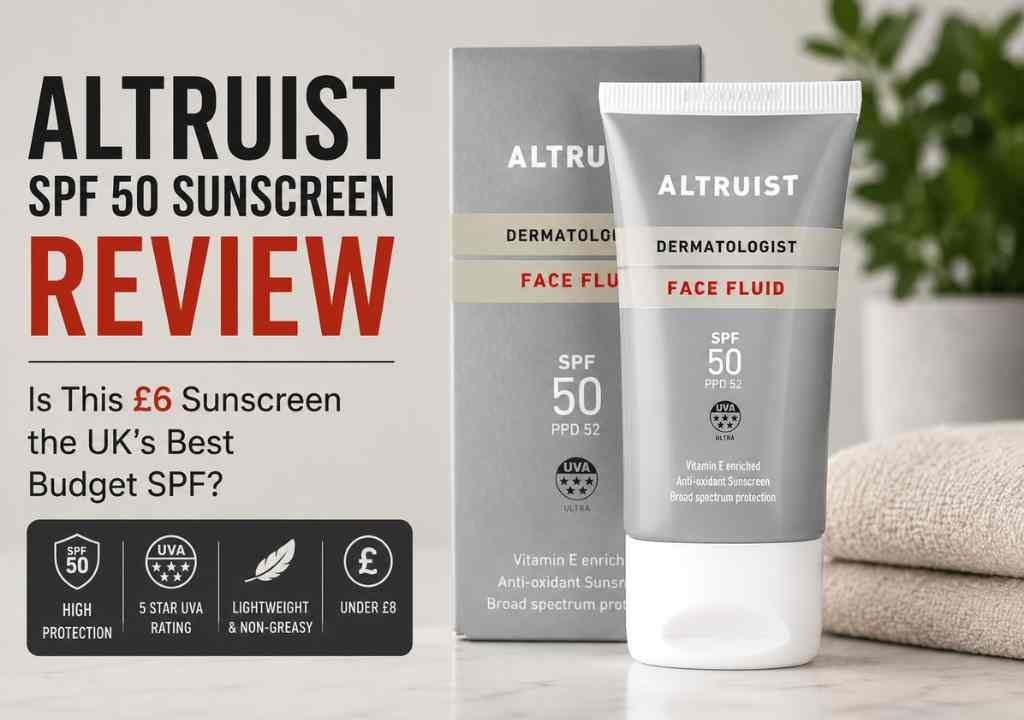
This Altruist SPF 50 sunscreen review UK looks at why a sun cream that costs under £8 has built such a loyal following among British skincare fans, and whether it actually holds up against premium SPFs three times the price. I first heard about Altruist through a dermatology nurse friend in Solihull, who mentioned it almost as an aside while we were queuing for coffee. She said it was “the one most dermatologists actually use themselves”, which is exactly the kind of comment that makes a cosmetic scientist sit up and pay attention.
As someone with a BSc in Cosmetic Science from the London College of Fashion, UAL, I get sent a fairly endless stream of sunscreens to try. Most are fine. Some are genuinely lovely. A small number make me want to write an article about them, and Altruist falls firmly into that last group, mainly because of how unusual its value proposition is for the UK market.
What Is Altruist SPF 50 and Why It Matters for UK Skin
Altruist is a UK sun protection brand developed by Dr Andrew Birnie, a dermatologist based in Sussex who specialises in skin cancer diagnosis and treatment. He reportedly created the range because he was frustrated that effective, broad spectrum sunscreen was priced out of reach for many of his patients, particularly those who needed to apply it daily and generously.
That backstory matters because sunscreen only works if people actually use enough of it, often enough. The NHS advises applying sunscreen liberally and reapplying every two hours, plus straight after swimming or towel drying, and a sun cream that costs £6 to £12 makes that advice much easier to follow than one priced at £30 a tube.
For UK women, particularly those of us living through grey winters and unpredictable summers, the temptation is to treat SPF as an occasional, holiday-only product. If you tend to drop sunscreen altogether between October and March, our guide to the best sunscreens for winter explains why that habit is worth breaking. Altruist’s pricing removes the financial excuse for skipping daily SPF, which is one reason this keyword has been climbing in search volume across the UK beauty space.
The Science: UV Filters Explained in Plain English
Altruist SPF 50 uses a mix of organic (chemical) and mineral UV filters, including Tinosorb S, avobenzone, octisalate, Uvinul T and Tinosorb A2B, alongside titanium dioxide. If that reads like alphabet soup, here is the simplified version.
Broad spectrum sunscreens need to filter both UVB rays (the ones that cause sunburn and play a major role in skin cancer risk) and UVA rays (the ones linked to premature ageing, fine lines and pigmentation). Many budget sunscreens only do the UVB part well, leaving UVA protection patchy. Altruist’s combination of filters, particularly Tinosorb A2B, is designed to give genuinely strong, photostable UVA coverage, which is why it carries a 5-star UVA rating on UK packaging.
In plain terms: SPF 50 tells you how well a product protects against UVB and sunburn, while the UVA star rating (out of five) tells you how well it protects against ageing and longer-term skin damage. You want both numbers to be high, and Altruist ticks both boxes without the heavy, white-cast finish that older mineral-only formulas were known for.
One thing worth flagging honestly: octocrylene, one of the filters used in some Altruist formulations, has been linked in a small number of studies to photo-contact allergy in people who are sensitive to ketoprofen or in children with reactive skin. It is not a reason to avoid the product for most adults, but if you have a known sensitivity, it is worth patch testing first, as you should with any new SPF.
My Experience Testing Altruist SPF 50
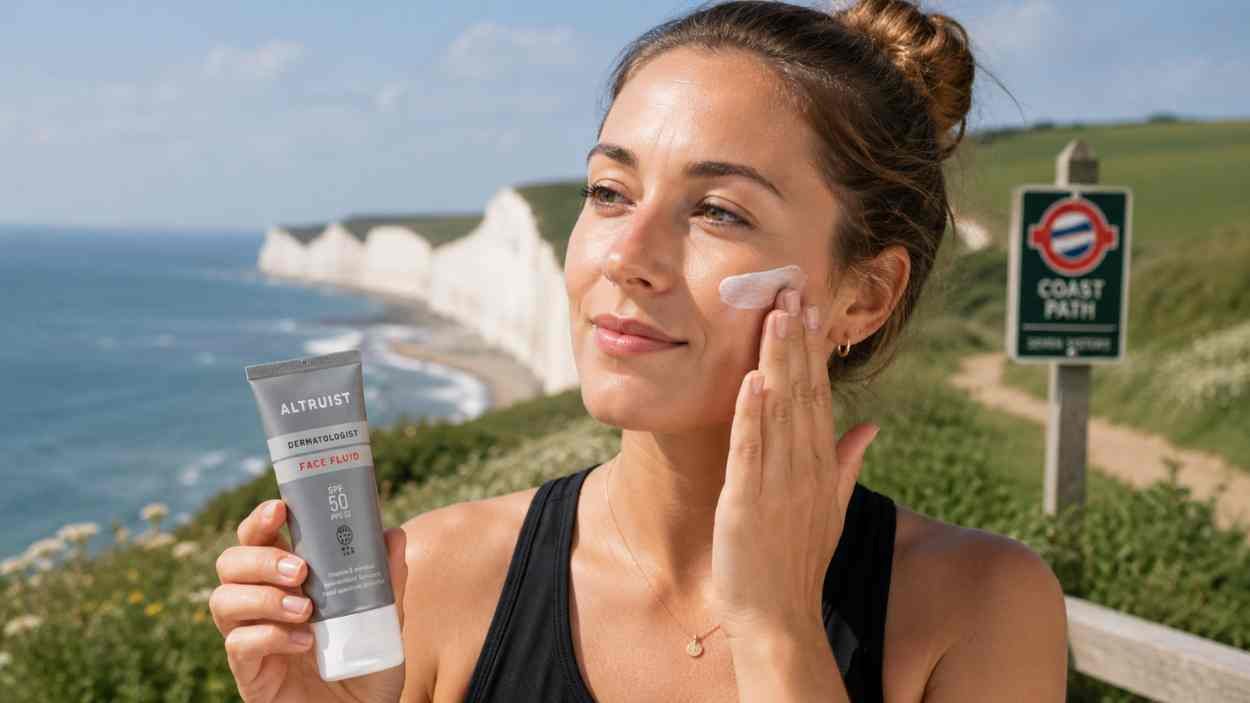
I tested the Altruist Dermatologist Sunscreen SPF50 face fluid daily for six weeks, through a mix of office days in Birmingham, a long weekend in Cornwall in late May, and several genuinely sweaty gym sessions.
The first thing I noticed was the texture. It sinks in within about 30 to 40 seconds, leaves no white cast on my medium-olive skin, and sits comfortably under makeup without that sunscreen “pilling” effect that ruins so many bases by lunchtime. I have combination skin with some hyperpigmentation around my cheeks, and after six weeks of consistent use, I genuinely noticed less new pigmentation forming, particularly compared to the same period last summer when my SPF habits were, frankly, inconsistent. If you prefer a dewier finish for combination skin, our roundup of Korean sunscreen for combination skin is worth a look alongside this one, though Altruist remains my everyday pick for value.
What surprised me, and this is the counterintuitive bit, is that the cheapest SPF in my entire bathroom cabinet turned out to be the one I reached for most consistently. I had assumed a budget price would mean a worse sensory experience, but the opposite was true. Because it felt more like a light moisturiser than a sun cream, I actually wanted to put it on, which sounds obvious but makes a real difference to compliance.
I did notice mild eye stinging if I applied too close to the lash line on hot, sweaty days, so I now apply slightly higher on the brow bone and let it settle before any activity that makes me sweat.
Altruist SPF 50 Price and Where to Buy in the UK
Part of why this Altruist SPF 50 sunscreen review UK keeps coming up in searches is simple: the price genuinely is unusual for this category. Altruist products are widely available on Amazon UK, with prices for the SPF 50 range typically sitting between £5.75 and £12.23 depending on size and format.
Here is how the range breaks down for UK buyers:
- Altruist Dermatologist Sunscreen SPF30, 200ml | Buy on Amazon | £6.25
- Altruist Sunscreen Face Fluid SPF30, 50ml | Buy on Amazon | £9.49
- Altruist Dermatologist Sunscreen SPF50, 2 x 100ml | Buy on Amazon | £12.23
At the time of writing, Altruist is not widely stocked in Boots or Superdrug, so Amazon UK and the brand’s own website remain the main routes for UK shoppers. If you are comparing against other budget options, it sits comfortably below LookFantastic’s mid-range SPF picks while matching or beating their UVA ratings.
Halal and Cruelty-Free Status
Halal status: Altruist’s sunscreens are fragrance-free, alcohol-free in the traditional perfumery sense, and formulated without animal-derived ingredients in their core ranges, though the brand does not currently hold a formal halal certification. Altruist states its products are not tested on animals. As always, I would recommend verifying current certification and full ingredient lists directly with the brand before purchase, as formulations can change between batches.
A Note for Hijab-Wearing Readers
If you wear a hijab, the areas of skin most exposed to UV throughout the day are your face, the front of your neck, and your hands, which makes a fast-absorbing, non-greasy SPF particularly useful. Altruist’s lightweight finish means it will not transfer onto fabric the way thicker, oilier sun creams can, which I tested deliberately by applying it generously before wrapping a light cotton scarf for several hours with no marking.
For women in the UK who spend long days outdoors during Ramadan in the summer months, or who simply walk to work, school runs or the shops, applying SPF to the face, neck and hands each morning covers the areas that genuinely need it, without adding another expensive step to your routine.
Who Should (and Shouldn’t) Choose Altruist SPF 50
Altruist SPF 50 is a strong fit if you want a daily, reapply-without-guilt sunscreen, you have combination or oily skin and dislike heavy textures, or you are managing hyperpigmentation and want consistent UVA protection without breaking the bank.
It may be less suited to you if you have a known sensitivity to octocrylene or chemical filters generally, in which case a mineral-only formula might suit you better, or if you specifically need a product with verified halal certification for personal or religious reasons.
Frequently Asked Questions
Is Altruist SPF 50 good for sensitive skin?
Yes, Altruist Dermatologist Sunscreen is formulated to be hypoallergenic, fragrance-free and free from common irritants such as lanolin and parabens, making it generally well tolerated by sensitive skin. As with any new product, patch test on your inner arm first.
Does Altruist SPF 50 leave a white cast?
In my six-week test on medium-olive skin, I found no visible white cast once the product had fully absorbed, which takes around 30 to 40 seconds.
Where can I buy Altruist SPF 50 in the UK?
Altruist SPF 50 is mainly available through Amazon UK and the brand’s official website, altruistsun.com. It is not currently widely stocked in major UK high street pharmacies.
Is Altruist SPF 50 suitable for daily use under makeup?
Yes, its lightweight, fast-absorbing finish makes it suitable as a base layer under foundation or tinted moisturiser without pilling, in my experience.
How does Altruist SPF 50 compare to The Ordinary’s SPF?
Both sit at the budget end of the market, but Altruist carries a 5-star UVA rating and was developed specifically by a UK dermatologist focused on daily, generous application, whereas The Ordinary’s UV Filters SPF45 has had more mixed feedback on texture for some users.
The Bottom Line
For under £8, Altruist SPF 50 delivers broad spectrum, high UVA protection in a texture that actually encourages daily use, which is, in the end, the most important feature any sunscreen can have.
For more on building a daily SPF habit, see our guides on the MyBreezyLife UK skincare guide, how to get rid of dark spots on your face, the best niacinamide serum UK, the best toner for oily skin UK and retinol before and after, all on MyBreezyLife.
Beauty & Wellness content at MyBreezyLife is created by our editorial team and reviewed by founder Noreen Fahad. Clinical claims are referenced. This article may contain affiliate links. We only recommend products we genuinely rate.