Pilates for beginners at home needs three things: a bit of floor, twenty minutes, and the willingness to move much more slowly than feels natural. That last one is the hard part. I’m Yasmin Demir, Health & Fitness Editor at MyBreezyLife, and as a REPs Level 3 personal trainer with a Sport Science degree from Brunel University, I have taught this exact routine to dozens of clients in North London living rooms, including my own in Haringey. No reformer machine, no studio membership at £25 a class, no special kit beyond a folded towel if you don’t own a mat.
Quick answer: For pilates for beginners at home, perform five moves: pelvic tilts, dead bugs, glute bridges, bird dogs, and modified side plank, in order, three times through, for a 20-minute session. Start with two sessions of two rounds in week one, progressing to three rounds in week two and three sessions by week three.
In this article
- New draft pilates: What Pilates Actually Does (In Plain English)
- Pilates for Beginners at Home: The Five Starting Moves
- The Three Mistakes I Correct Most Often
- Your First Four Weeks: A Realistic Plan
- Two Minutes Before and After
- Modifications: Make It Yours
- Training Modestly at Home
- Making It Stick When Life Is Busy
- How Pilates Fits Alongside Everything Else
- FAQ: Beginner Pilates at Home
This guide gives you the five moves I start every beginner with, the mistakes I correct most often, and easier, harder and Ramadan-safe versions of the whole routine.
What Pilates Actually Does
Pilates is low-impact strength work built around control, breath and your deep core muscles. Not the six-pack muscles you can see, but the layer underneath, the transversus abdominis, which wraps around your middle like a corset and stabilises your spine every time you lift a child, a kettle or a shopping bag.
Because the movements are slow and precise, Pilates strengthens without jarring your joints, which is why the NHS exercise guidelines list it as a recommended strength-building activity for adults of every fitness level. Research consistently links regular Pilates practice with reduced lower back pain and better balance, and in my own client work the change I see first is posture. Within about four weeks, people simply sit and stand differently.
Here is the counterintuitive bit: slower is harder. Beginners always want to speed up because speed lets momentum do the work. If a move feels easy, you are almost certainly rushing it, and yes, that means the fix for “too easy” is usually to slow down, not add more.
Pilates for Beginners at Home: The Five Starting Moves
Do the moves in order, three times through, and you have a complete 20-minute session. Breathe in through the nose to prepare, out through the mouth on the effort.
1. Pelvic tilts, 10 reps
Lie on your back, knees bent, feet flat. Gently rock your pelvis so your lower back presses into the floor, then release. Small movement, big payoff. This wakes up the deep core and teaches the control everything else depends on.
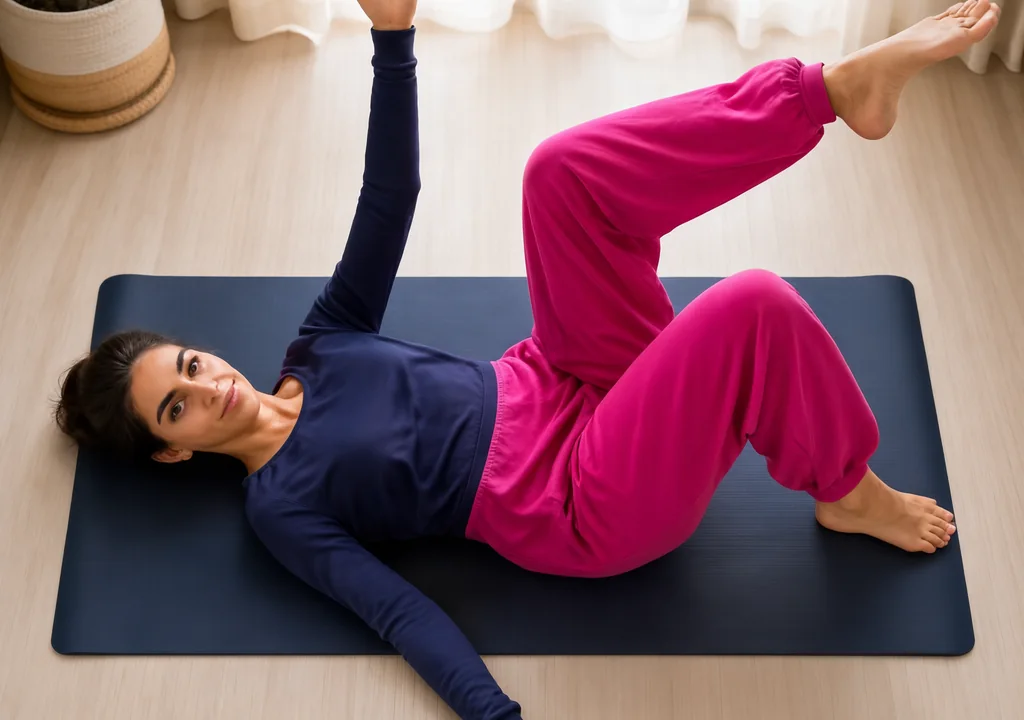
2. Dead bugs, 8 per side
Still on your back, arms up, knees stacked over hips. Lower your right arm and left leg towards the floor, slowly, without letting your lower back arch. Return and swap. If your back pops off the floor, shrink the range.
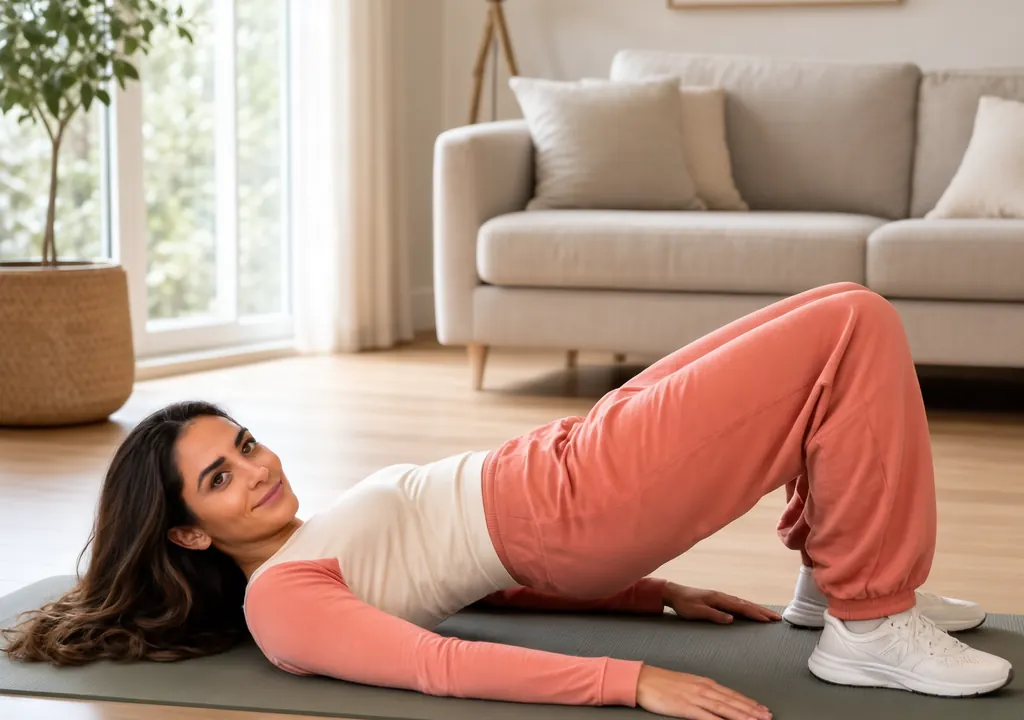
3. Glute bridges, 10 reps
Feet flat, knees bent. Peel your spine off the floor one vertebra at a time, pause at the top, and lower back down just as slowly. The peeling action, not the height, is the point.
4. Bird dogs, 8 per side
On hands and knees, extend your opposite arm and leg until they are level with your back, hold for two breaths, return. Imagine balancing a cup of tea between your shoulder blades. Wobbling is normal and is actually the exercise working.
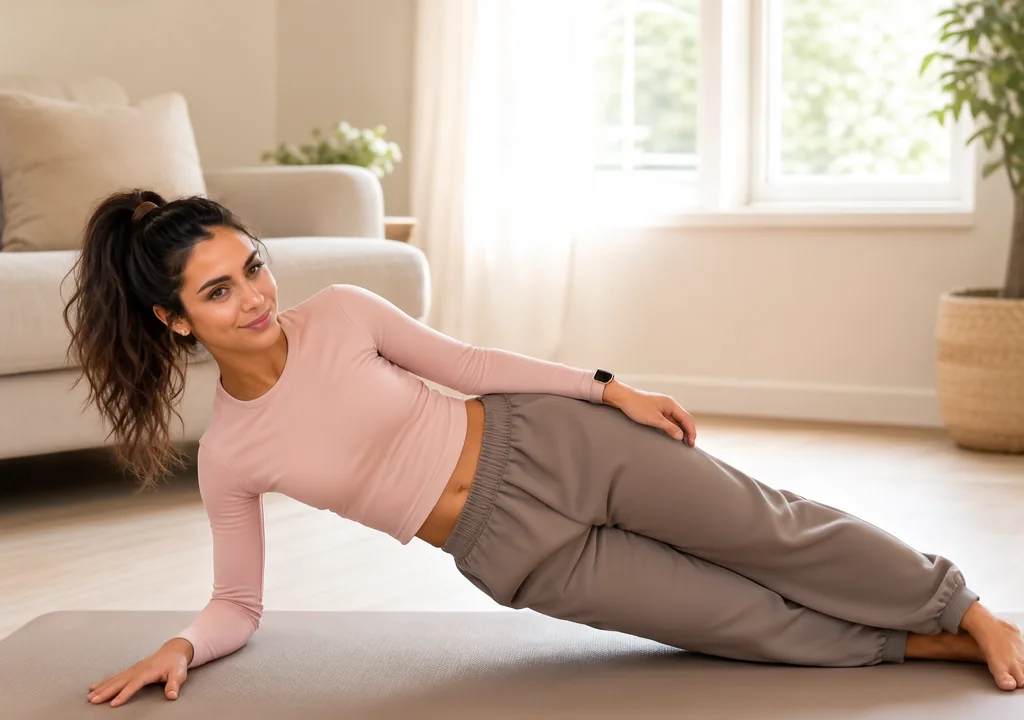
5. Modified side plank, 20 seconds per side
From your knees rather than your feet, lift your hips and hold. This one protects your waist and lower back for everything else you do all week.
Sore around your middle two days later? That’s DOMS, delayed onset muscle soreness, and it’s a normal sign of adaptation rather than injury. Working the same muscles gently actually eases it.
The Three Mistakes I Correct Most Often
Holding your breath is the big one. Almost every beginner does it during dead bugs, usually without noticing, and it makes the whole exercise harder and shakier. If you catch yourself going silent and rigid, exhale audibly on the effort. Talking yourself through the reps sounds silly and works brilliantly.
Gripping the neck comes second. During anything on your back, the neck should stay long and relaxed, chin gently tucked as if holding a peach under it. If your neck aches after core work, the neck was doing the core’s job.
The third mistake is chasing range instead of control. A dead bug where your arm only lowers halfway, slowly and with a stable spine, beats a full-range one where your back arches off the floor. In every session I taught at the women-only gym in North London, the person doing the smallest, slowest version was almost always doing the most effective workout in the room.
Your First Four Weeks: A Realistic Plan
Week one: two sessions, two rounds each, easier versions throughout. The goal this week is simply showing up twice and learning the movement shapes.
In week two, do two sessions of three rounds. Start paying attention to your breath pattern. Expect a little DOMS after the first session of the week; it fades faster each time.
Week three: three sessions, three rounds, standard versions. This is usually the week people notice they are sitting up straighter at their desk without trying.
By week four, keep the three sessions but slow everything down to a four-second count. Same moves, dramatically harder, and the clearest sign of progress you can give yourself without any equipment.
After the four weeks, either keep the routine as a maintenance habit or graduate to longer follow-along classes. There is no rush. Consistency at twenty minutes beats ambition at sixty.
Two Minutes Before and After
Before you start, march on the spot for thirty seconds, roll your shoulders backwards five times, and do five slow cat-cow stretches on all fours. Cold muscles do not like precise work, and this tiny warm-up makes the first round feel completely different.
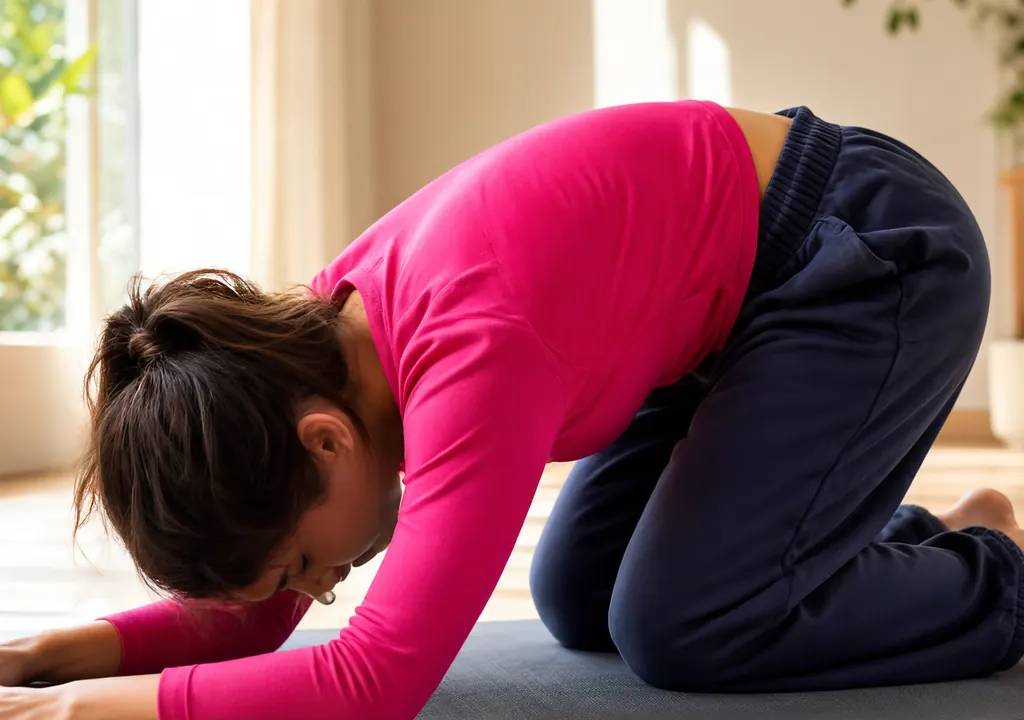
Afterwards, take one minute in child’s pose, knees wide, arms long. Breathe into your back. It rounds off the session and doubles as a genuinely calming pause in the day, which for busy women is half the reason to do Pilates at all.
Modifications: Make It Yours
Easier version: halve the reps, rest for a full minute between rounds, and do two rounds instead of three. Consistency beats intensity every single time. Three short sessions a week will change more than one heroic one.
Harder version: slow every rep down to a four-second count, add a fourth round, or hold a water bottle in the working hand during bird dogs. Progressive overload, which simply means gradually asking a little more of your muscles over time, works just as well with body weight as it does with barbells.
Ramadan-safe version: do two gentle rounds after Iftar, leaving at least two hours after eating. Keep everything at half effort during the first week of fasting. Sip water between rounds and aim for two to three litres across the evening. In my own Ramadan training this year I moved this exact routine to around 10pm and it felt completely sustainable. Consult your GP if you experience dizziness or weakness while fasting, and see our slow-release energy Suhoor meal plan for the food side of the equation.
Training Modestly at Home
One of the quiet advantages of home Pilates is that the modesty question mostly answers itself: your living room, your rules, no mirrors, no audience. Loose joggers and a long-sleeve top from H&M Sport or Decathlon work perfectly well. Pilates never requires tight clothing, whatever the studio marketing suggests. If you prefer a structured session with covered options, Decathlon’s £14.99 mats and a free YouTube class do the job of a £25 studio visit.
Timing around prayer is straightforward too. The routine fits neatly between Maghrib and Isha for most of the year in the UK, and because there are no jumps, you can do it in a flat without a downstairs neighbour complaint.
Comfort Yoga Mat 8mm at Decathlon UK £14.99 at time of writing Long-Sleeve Loose Training Top at H&M £12.99 at time of writing
Making It Stick When Life Is Busy
Motivation isn’t the problem most of my clients think it’s. Logistics are. The routine that survives is the one with the fewest steps between deciding and starting, so leave your mat, or the folded towel, somewhere visible rather than in a cupboard. A mat you can see gets used roughly twice as often; a mat you have to fetch becomes furniture.
Anchor the session to something that already happens every day. After the school run, after Maghrib, after the kettle goes on for your evening tea. Habit research calls this stacking; I call it not relying on willpower at 8pm, because nobody has willpower at 8pm.
Shrink the session before you skip it. On the days twenty minutes feels impossible, do one round in seven minutes and count it as a win, because physiologically it is one. The all-or-nothing mindset has ended more fitness routines than injury ever has, and the women I have trained who made lasting change were never the most intense. They were the ones who kept turning up in some form, every week, through school holidays and Ramadan and everything else.
How Pilates Fits Alongside Everything Else
Pilates is your foundation, not the whole house. Pair it with brisk walking or the routines in our home workout for women beginners plan for strength, and if you are weighing up cardio options, our guide to the difference between HIIT and cardio explains where each fits. On busy weeks, even the 7 minute workout slots in alongside two Pilates sessions nicely.
As a personal trainer I have seen more people stick with Pilates than any other home exercise, and I think the reason is simple: it never leaves you too wrecked to do tomorrow’s session.
FAQ: Beginner Pilates at Home
Can I really learn Pilates at home without an instructor?
Yes, with beginner-appropriate moves like the five above. Keep ranges small, move slowly, and film yourself once a week on your phone to check your form against the cues.
How often should a beginner do Pilates?
Two to three 20-minute sessions a week is ideal. Daily practice is safe because it is low-impact, but rest days make no difference to results at this stage.
Do I need equipment for Pilates at home?
No. A mat or thick towel is enough. Reformer machines are lovely and completely optional; mat Pilates delivers the same core benefits.
Is Pilates enough exercise on its own?
It covers strength and flexibility well, but adults also need some moderate cardio each week, per NHS guidance. A brisk daily walk alongside Pilates covers both.
How long until I see results from Pilates?
Most beginners feel a difference in posture and core control within three to four weeks of consistent practice. Visible strength changes take a couple of months.
Roll out a towel tonight, do one slow round, and let that be enough to start.
Health & Fitness content at MyBreezyLife is created by our editorial team and reviewed by founder Noreen Fahad. This is general guidance only. Always consult a qualified professional for personal health advice. For mental health support, contact Mind UK at mind.org.uk or Samaritans on 116 123.