
When it comes to pilates beginners home, pilates for beginners at home is one of the most searched fitness terms in the UK right now, and I understand exactly why. It promises genuine results, it requires almost no equipment, and you can do it in your living room without disturbing anyone downstairs. As someone with a BSc in Sport and Exercise Science from Brunel University and a REPs Level 3 Personal Trainer certification, I have been recommending home Pilates to women who are new to exercise for years. The results are real. The barrier to entry is almost nothing. And the counterintuitive truth is that you will probably feel this more than you expect from something that looks so gentle.
In this article
Let me get you started properly.
Pilates beginners home: What Is Pilates and Why Does It Actually Work?
Pilates is a low-impact exercise method focused on controlled movement, core strength, and body alignment. It was developed by Joseph Pilates in the early twentieth century and has a genuinely strong evidence base. A 2015 review published in the Journal of Orthopaedic and Sports Physical Therapy found that Pilates training significantly improved core muscle endurance, flexibility, and balance in participants across a range of age groups and fitness levels.
The reason it works so well for beginners is the emphasis on quality over quantity. You are not asked to go fast, lift heavy, or push through pain. You are asked to move precisely. That precision is what builds the deep postural muscles that most exercise forms skip entirely. After a month of consistent Pilates practice, most women I have worked with notice improved posture, reduced lower back tension, and better body awareness in daily life. Those are not small things.
The key muscles targeted in mat Pilates are the transverse abdominis (your deepest core layer), the pelvic floor, the glutes, and the muscles along the spine. These are the muscles responsible for how you stand, sit, and carry yourself. Building them creates a foundation that makes every other form of movement easier.
What You Need to Start Pilates at Home
Here is the honest answer: a mat and a floor. That is it.
A Pilates mat is slightly thicker than a standard yoga mat (around 10-15mm rather than the usual 3-5mm) because several exercises involve rolling through the spine and a thin mat does not offer enough cushioning. If you already own a thick yoga mat, use it. If you are buying one, the Liforme Travel Mat is excellent at around £70 if you want an investment piece, but the Amazon Basics exercise mat at around £18 is perfectly functional for home use when you are starting out.
Thick Pilates Mat 10mm | Amazon UK | £18 | Buy on Amazon
Beyond the mat, everything else is optional. A small resistance band (around £8 from Amazon UK or Decathlon) can add variety to leg and glute work once you are comfortable with the basics, but you will not need it for your first several weeks.

The 20-Minute Beginner Pilates Routine
This is the routine I give to clients who are starting Pilates from scratch. It covers all the foundational movements and can be done in around 20 minutes. Read through all the instructions once before you start. Pilates breathing (inhale to prepare, exhale on the effort) is part of the technique, not an afterthought.
Before you begin: Lie on your mat and spend two minutes simply breathing. Inhale through the nose to expand the ribcage laterally, exhale through the mouth to gently draw the lower belly inward. This is your Pilates breath and it should accompany every movement.
1. The Hundred (Modified)
Lying on your back, bring knees to tabletop position (shins parallel to the floor, knees directly above hips). Lift your head and shoulders slightly off the mat. Pump your arms in small up-and-down movements, 5 pumps on the inhale, 5 pumps on the exhale. Build to 100 pumps total.
This activates the deep core and establishes the Pilates breathing pattern. Do 3 sets of 20 pumps to start, building to the full 100 over several weeks.
2. Single Leg Stretch
From the same starting position, extend one leg out to a 45-degree angle while pulling the opposite knee towards the chest. Alternate legs in a controlled pulling motion. Keep your lower back pressed gently into the mat throughout. Do 10 repetitions each side.
3. Spine Stretch Forward
Sit tall with legs extended in front of you, feet hip-width apart. Inhale to grow tall. Exhale as you round forward, reaching arms towards feet while drawing the belly gently inward. Inhale to hold. Exhale to return to sitting tall. Do 8 repetitions.
4. The Roll-Up
Lie on your back, arms reaching overhead. Inhale to begin. Exhale to slowly peel off the mat vertebra by vertebra, reaching forward over your legs. Inhale. Exhale to roll back down with the same control. If your lower back is tight, bend your knees slightly. Do 5 to 8 repetitions. Go slowly. This is not a sit-up.
5. Glute Bridge
Feet flat on the mat, knees bent. Exhale as you slowly press through the feet and lift the hips until you form a straight line from knees to shoulders. Hold for two breaths. Inhale as you lower back down. Do 10 repetitions, 2 sets.
6. Side-Lying Leg Series
Lie on your side with legs stacked, body in a straight line, bottom arm extended under your head. Lift the top leg to hip height and move through a small controlled range: forward (inhale), back (exhale). Keep the hip stacked throughout. Do 12 repetitions each side.
7. Cat-Cow Stretch (Cool Down)
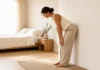
On all fours, hands under shoulders, knees under hips. Inhale as you let the belly drop and lift the tailbone (cow). Exhale as you round the spine upward and tuck the tailbone under (cat). Move slowly and breathe fully. Do 8 slow repetitions. Brilliant for anyone with desk-related lower back tension.
Modifications
Easier version: For The Hundred and Single Leg Stretch, keep both feet on the floor rather than lifting to tabletop. For the Roll-Up, stay seated and practise just the top half of the movement. All exercises can be slowed down further.
Harder version: Extend legs lower to the floor in The Hundred for more core challenge. Add a resistance band around the thighs during the Glute Bridge. Progress the Roll-Up to legs fully extended.
Ramadan-safe version: This routine is well suited to the post-Iftar window, at least two hours after eating. Reduce to three exercises (Glute Bridge, Spine Stretch, Cat-Cow) if energy is limited. Drink at least one full glass of water before starting. If you experience dizziness at any point, stop and rest. Consult your GP if dizziness or weakness during fasting is a regular concern.
Pilates for Modest Fitness: What to Wear and Where to Train
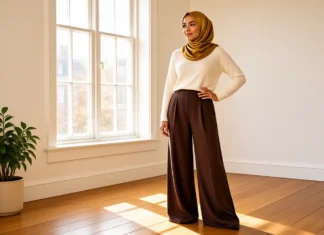
One of the things I genuinely love about Pilates for home practice is how completely it suits modest fitness. All movements are low-impact and floor or mat-based, with no jumping or fast movement that would make loose clothing a practical issue. A long-sleeve fitted base layer, wide-leg joggers, and socks are the most popular choice among women I train modestly.
For modest activewear that works well with Pilates: Covered Active’s long-sleeve tops at around £32 stay tucked in during all the floor work without any adjusting. Decathlon’s soft-touch leggings worn under a tunic are another excellent combination at a very accessible price.
Long-Sleeve Sports Top | £32 | Buy on Amazon
Soft-Touch Leggings | £12 | Buy on Amazon
If you train around prayer times, Pilates fits naturally into shorter windows. The full 20-minute routine fits comfortably between Dhuhr and Asr, or can be split across two smaller sessions. The NHS Strength and Flex app is a free resource worth downloading alongside your Pilates practice.
Frequently Asked Questions
How often should I do Pilates as a beginner?
Start with two to three sessions per week. Your muscles need time to adapt, particularly the deep core and postural muscles that may be underused. Three sessions per week for the first month is an excellent starting point.
Do I need a reformer to do Pilates at home?
No. Reformer Pilates is a studio-based variation using a machine, but mat Pilates is the original form and is equally effective. All you need is a mat.
How long before I see results from Pilates?
Most beginners notice improved posture and reduced lower back tension within two to three weeks. Visible core strengthening typically becomes apparent at the six to eight week mark. Regular practice over months is where the most significant change occurs.
Is Pilates safe during Ramadan?
Yes, when adjusted appropriately. Train after Iftar (at least two hours after eating), reduce intensity if energy is lower, and prioritise hydration between Iftar and Suhoor. This routine’s low-impact nature makes it one of the most Ramadan-compatible exercise methods available.
Can I do Pilates if I have lower back pain?
Many people find Pilates helpful for lower back pain because it builds the core and postural muscles that support the spine. However, if you have an existing injury or diagnosis, consult your GP or physiotherapist before starting.
For more on building a sustainable fitness routine, read our guide to home workouts for women beginners and our articles on how to improve sleep quality and how to reduce stress naturally.
Twenty minutes. That is genuinely all it takes. Start with this routine twice this week, just twice, and see how you feel by Sunday. Most women I have introduced to Pilates come back with the same observation: they did not expect to feel it that much from something that calm. That is Pilates doing exactly what it is supposed to do.
Health & Fitness content at MyBreezyLife is created by our editorial team and reviewed by founder Noreen Fahad. This is general guidance only. Always consult a qualified professional for personal health advice. For mental health support, contact Mind UK at mind.org.uk or Samaritans on 116 123.