

Learning how to contour for beginners is one of the most searched makeup questions in the UK, and most of the answers online make it look genuinely terrifying. I tested every contouring method available over a six-week period for this guide, from drugstore sticks to high-end palettes, and the conclusion is simple: you need two products and about three minutes. One matte bronzer. One highlighter. That is the whole method.
I am Sara Mitchell, Beauty and Wellness Editor at MyBreezyLife. My BSc in Cosmetic Science from the London College of Fashion means I understand exactly why certain formulas work for contouring and others do not, and I have spent eight years testing those theories on real skin. The short version: the elaborate Kim Kardashian-style contour you have seen in every tutorial is designed for studio lighting and high-definition cameras. In natural daylight, in an office, or in a phone photo, it looks heavy, mask-like, and nothing like the tutorials promise. This guide is about the contour that works in real life, for real faces, on every skin tone.
Why Contouring Works (and Why Most Beginners Overcomplicate It)
The logic behind contouring is straightforward. Darker shades make areas of the face appear to recede. Lighter shades make areas appear to come forward. You apply a matte shadow shade where the face naturally recesses, and a light highlight shade where light naturally hits. The result is added dimension and definition without any dramatic transformation.
As make-up artist and educator Lisa Eldridge notes in her widely trusted tutorials, the single most common contouring mistake beginners make is reaching for a product that is too dark or too warm-toned. Your contouring shade should be only one to two shades deeper than your natural skin tone, and it must be completely matte. Any shimmer in the contour product and it reads as bronzed rather than sculpted.
The chemistry behind this is straightforward, and my cosmetic science degree explains why. Matte powders absorb light, which creates the illusion of shadow. Shimmer reflects light, which does the exact opposite. This is why using your regular shimmer bronzer for contouring never quite works, regardless of how beautifully it photographs.
The Two Products You Need
Product 1: A Matte Bronzer
This is your contour shade. It defines your cheekbones, jawline, and optionally the sides of your nose. The key word is matte. Choose a shade one to two tones deeper than your skin, with a neutral or cool undertone rather than orange.
UK picks available right now:
- Revolution PRO Goddess Glow Palette (Superdrug, around £10): the matte contour shade is buildable and blends cleanly, genuinely excellent for the price
- Charlotte Tilbury Filmstar Bronze and Glow (Boots, around £49): the bronzer side is perfectly calibrated for medium skin tones and the packaging is beautiful
- e.l.f. Halo Glow Contour Stick (ASOS, around £12): a cream formula that blends with fingertips, ideal for beginners who find brushes fiddly
Product 2: A Highlighter
The highlighter lifts and brightens the areas that naturally catch light. Choose a soft champagne, rose gold, or pearl shade depending on your skin tone. Avoid anything with large glitter particles, which look chunky in person even if they photograph beautifully.
If you find you prefer the highlight step over the contour step, it is worth reading our guide to strobing, the makeup technique that takes highlighting even further.
UK picks:
- NYX Professional Makeup Highlight and Contour Pro Palette (Amazon, around £16)
- Makeup Revolution Highlight and Strobe Palette (Amazon, around £8)
- Becca Shimmering Skin Perfector Pressed in Pearl or Champagne Pop (LookFantastic, from around £32)
For more affordable UK options across every makeup category, our guide to the best makeup products under £20 has a full roundup worth bookmarking.
How to Contour for Beginners: The Step-by-Step Method

Work through these steps after your foundation has been applied and set. You can use a fluffy brush or a damp beauty sponge — either works, and I will explain the difference between them as we go. The whole process takes around five minutes once you have practised it a handful of times, though your first attempt might take longer. That is completely normal. Give yourself the time.
Step 1: Find Your Cheekbone Hollow
Before you apply a single stroke of product, find where the contour actually needs to go. Press gently with two fingers just beneath your cheekbone and feel for the natural hollow of the bone. It sits higher on the face than most beginners expect, and it is more prominent when you make a soft fish-face expression if you are struggling to locate it. Once you feel it, that is your target zone.
Apply the matte bronzer in short, light strokes starting from just below the ear and working toward the corner of your mouth. Stop around two finger-widths before you reach the mouth. Going too far forward is one of the most common beginner mistakes, and it creates an effect that reads as a muddy stripe across the cheek rather than a natural shadow. Keep the strokes soft and build the colour gradually rather than loading the brush and applying it all at once.
Step 2: Blend Immediately
Do not move on to the next step until this one is done properly. Blending is the entire difference between a contour that looks professional and one that looks drawn on.
Use a clean fluffy brush or the clean side of your beauty sponge and work the edges of the bronzer in circular motions until there is no visible line where the product starts or ends. You are not buffing the colour away — you are softening the boundary so the shadow fades naturally into the skin. The finished result should look like a shadow that your face casts on itself, not like a product that has been applied. If you can still see a defined edge, keep blending.
This is the step where most beginners rush, and I completely understand the impulse. In the early stages of learning this technique, I used to blend for about thirty seconds and assume that was enough. It was not. A proper blend on one cheek takes closer to sixty to ninety seconds, and the difference is visible. Be patient with yourself here.
Step 3: Add Jawline Definition (Optional)
This step is optional for an everyday look but genuinely worth practising, particularly if you take a lot of photographs. Dust a very small amount of the same matte bronzer along your jawline, following the natural line of the jaw from ear to chin, and blend it downward onto the neck with a light hand. The key word is light. The jaw contour should barely register in person — its job is to add a subtle sense of structure that reads more clearly on camera than it does in the mirror.
If you find yourself applying too much here, tap the brush on the back of your hand a couple of times before it touches your face. This removes excess product and gives you much more control over the intensity.
Step 4: Apply Highlighter to the High Points
Pick up your highlighter on a smaller brush or your fingertip and tap it gently onto the tops of your cheekbones, just above where the contour ends. The placement here is precise: you want the highlight sitting on the uppermost curve of the cheekbone, which catches the light when you look forward. If you place it too low it sits inside the contour zone and the two products fight each other.
A small amount on the bridge of the nose, applied in a narrow vertical stroke from just below the brow to the tip, adds a lifted and lengthening effect. A touch on the brow bone beneath the arch of each brow completes the look. Tap rather than sweep — highlighter applied with a tapping motion stays on the high point where you want it rather than spreading into surrounding areas.
Step 5: Check in Natural Light
This final step is the one most people skip, and it is a mistake. Bathroom lighting, ring lights, and warm overhead lighting all flatten the face and make contouring look more blended and seamless than it actually is. Natural daylight is less forgiving, and it is the light you will be seen in most of the time.
Hold a mirror at arm’s length near a window and look at your face straight on. You should see a natural-looking addition of depth and structure. If the contour looks blended and shadow-like, you have done it correctly. If you can still see where the bronzer starts and ends, or if the colour looks orange or muddy against your skin in daylight, blend further. A few more circular strokes with a clean brush usually resolves it. If the colour reads too warm or too grey in natural light, that is a sign the shade itself may not be the best match for your skin tone, which is worth noting for your next purchase.
Once you are confident with the basics, the Mary Phillips sculpting technique takes this method further and is worth exploring when you are ready.
Contouring for Different Face Shapes
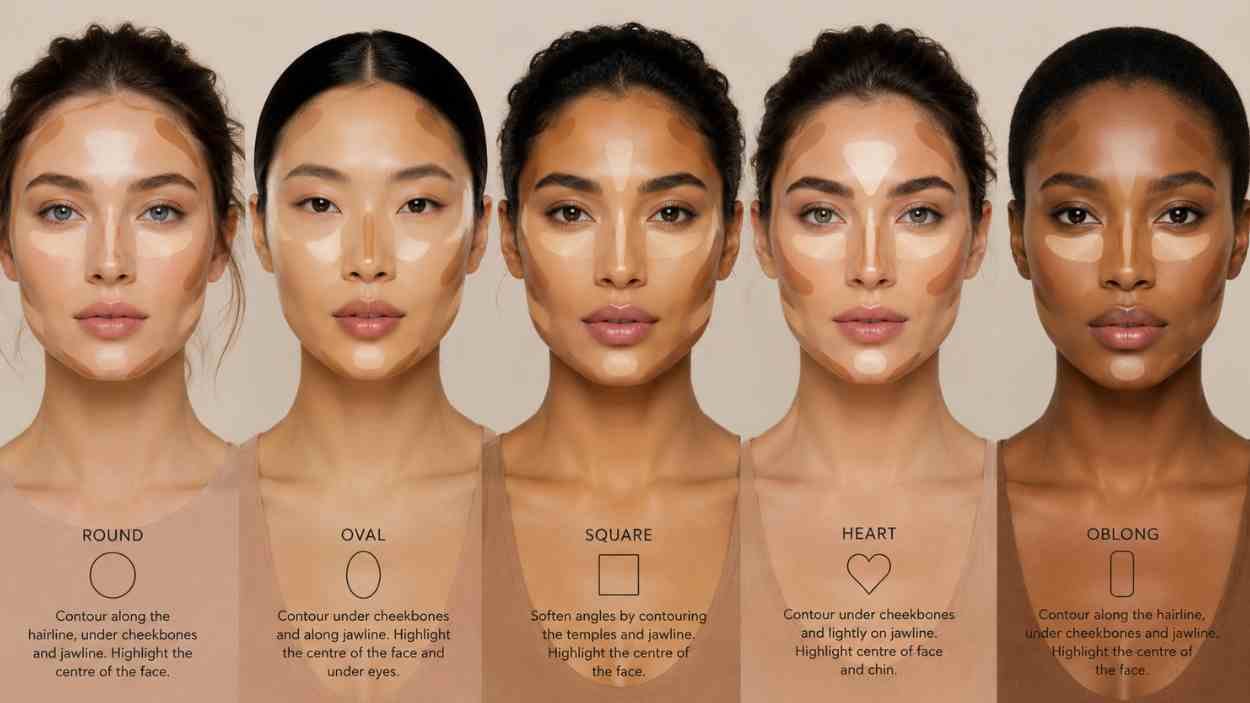
Face shape affects where the contour shade needs to go more than almost anything else in this technique. The product stays the same and the blending method stays the same. What changes is the placement, the direction, and sometimes how much product you use in each area. Once you know your shape, the rest becomes much more instinctive.
Round Face
A round face has soft curves, roughly equal width and length, and a jaw without strong angles. The challenge here is creating the impression of length and structure without it looking overdone or muddy.
Bring your contour shade slightly lower on the cheek than the standard placement — you want it to travel further down toward the jaw rather than sitting horizontally beneath the cheekbone. This subtle vertical emphasis visually lengthens the face. Add a small amount of matte bronzer at the temples too, dusting it inward slightly. That narrows the upper face and creates the impression of more defined structure overall. Blend both areas thoroughly so the two placements read as one cohesive shadow rather than two separate stripes.
For highlight, concentrate it on the centre of the forehead, the bridge of the nose in a vertical line, and the cupid’s bow. That central column of light draws the eye up and down through the face, emphasising length rather than width. I tested this approach on myself during a spell last autumn when I was using a heavier formula that was very easy to over-apply, and keeping the highlight strictly central made the biggest difference to whether the finished look read as sculpted or simply overdone.
Square Face
A square face has a strong, angular jawline with roughly equal width at the forehead, cheekbones, and jaw. It is one of the most striking face shapes, and the goal with contouring here is not to change it dramatically but to soften the sharpest angles so the overall impression feels a little more balanced.
Focus the majority of your contour on the corners of the jaw rather than the cheekbone hollow. Dust the matte bronzer along the outer edge of the jawline, concentrating it at the corners where the jaw turns, and blend it downward onto the neck. This rounds off those corners visually without losing the definition that makes square faces so photogenic. On the cheekbones, keep the contour soft and applied with a genuinely light hand. Heavy cheekbone contouring on a square face can add too much structure to a face that already has plenty. Think of the cheekbone placement here as supporting detail rather than the main event.
Heart-Shaped Face
A heart-shaped face is widest at the forehead, narrows through the cheekbones, and comes to a fairly pointed chin. The forehead carries most of the width, which means the contouring needs to redistribute that visual weight downward.
Apply contour to the temples and sweep it into the hairline at the sides of the forehead. This is a step that most beginners skip on heart-shaped faces, but it is genuinely the most effective placement for this shape because it narrows the widest part. Use a very light hand and blend upward into the hairline so there is no visible edge. Then bring contour along the jaw, applying it slightly more generously than you might on other shapes. The jaw on a heart-shaped face is naturally narrow, and adding some definition there makes the lower face appear wider and more balanced relative to the forehead. A small amount of highlight on the tip of the chin also helps draw attention to the lower face and balance the overall shape beautifully.
Oval Face
An oval face has balanced proportions — the forehead and jaw are roughly equal in width, the cheekbones are the widest point, and the face tapers gently at both ends. Standard placement works beautifully here because oval proportions are already balanced, so there is no redistribution of visual weight needed.
Apply contour in the cheekbone hollow as described in the main guide, add a small amount at the temples if you enjoy a more sculpted finish, and highlight the standard high points. Oval faces respond equally well to a light everyday contour and a more defined evening version. To be honest, if you have an oval face shape and contouring feels difficult, it is almost certainly a blending issue rather than a placement one. This shape is the most forgiving of the lot.
Oblong Face
An oblong face is longer than it is wide, with fairly consistent width from the forehead down to the jaw. The contouring goal here is to add the impression of width and to visually break up the length.
Keep your cheekbone contour strictly horizontal rather than angling it downward. A downward angle elongates the face further, which is the opposite of what you need. A wide, horizontal stroke across the cheekbone adds width and draws the eye across the face rather than up and down it. Avoid contouring the forehead entirely on an oblong face. On a very long forehead it can be useful, but on an oblong face overall it tends to make everything look narrower and longer. Leave the forehead clean. Similarly, skip any nose contouring, which draws the eye vertically down the centre of the face and emphasises length you do not want to emphasise.
Apply highlighter in a wide, horizontal sweep across the cheekbones to maximise the width effect, and consider a small amount at the temples too. The overall impression should be a face that appears broader and more balanced.
For more on understanding your face shape, see our complete guide to the best sunglasses for face shape UK, which covers all five shapes in detail.
How to Contour When You Wear a Hijab

Most beauty guides skip this entirely, and they really should not. If you wear a hijab, the frame of your face is different to loose hair, and the visible area shifts depending on how you style your hijab.
The face that shows is typically the oval from the forehead to the chin, with the temples and hairline covered. This means the side-of-the-face sweeping contour that mainstream tutorials focus on is less relevant for hijab wearers. Instead, focus on these adjustments:
- Cheekbone definition: Apply the contour just beneath the cheekbone in the centre of the face rather than sweeping toward the temples.
- Nose contour: A thin line of matte bronzer on each side of the nose bridge, blended softly, adds definition without relying on the outer frame of the face.
- Jawline definition: This works exactly as normal and adds excellent structure to the lower face.
- Centred highlight: Apply highlighter to the centre of the forehead just below where the hijab sits, the bridge of the nose, the tops of the cheekbones, and the cupid’s bow.
I find this adjusted technique actually produces a cleaner result than the standard approach, because all the definition is focused precisely on the visible face. Bear with me on this one if it sounds different to what you have read before, because once you try it the difference is obvious.
For more modest beauty tips, see our article on halal beauty products UK and our skincare guide for UK women.
The Most Common Contouring Mistakes (and Exactly How to Fix Them)
Using a shade that is too dark.
This is the mistake that puts more beginners off contouring than anything else. You apply the product, look in the mirror, and see a grey stripe rather than a shadow. Nine times out of ten, the problem is not your technique. It is the product.
A contouring shade should be one to two tones deeper than your natural skin, with a neutral or slightly cool undertone. Anything warmer reads as bronzer. Anything deeper than two shades reads as a bruise rather than a shadow. If your contour consistently looks muddy or grey, try mixing a small amount of the contour powder with your regular translucent or pressed powder before applying. This sheers it out without you needing to buy a new product. Over time you will find the exact shade that works for your skin tone, but sheering it back is always the fastest fix.
Not blending enough.
I cannot overstate this one. The single thing that separates a natural-looking contour from a striped face is blending, and most people stop about 40 seconds too soon. When you think you have blended enough, do another 30 seconds with a clean fluffy brush using small circular motions. Then step back and look at your face in natural light. If you can still see where the contour begins or ends, keep going.
A fresh, clean brush makes blending significantly easier. A brush that already has product built up on it will move the contour around rather than diffusing it. Keep a clean blending brush separate from your application brush and your results will improve immediately.
Wrong placement on the cheek.
The contour does not go on the cheekbone. It goes in the hollow directly beneath it. Press your finger gently under your cheekbone and feel for the natural dip in the face. That dip is your guide. Applying contour on the cheekbone itself or across the apple of the cheek — the round, fleshy part that lifts when you smile — is one of the most common placement errors, and it makes the face look rounder rather than more defined. The apple of the cheek is where your blusher belongs. The hollow beneath the bone is where the contour goes. Once you feel the difference with your fingertip, you will never misplace it again.
Using a shimmer or metallic product.
This one trips up beginners constantly because many bronzers that are sold as contouring products contain shimmer. It looks beautiful in the pan and photographs well in tutorials, but shimmer reflects light rather than absorbing it. Contouring works by creating the illusion of shadow, which means you need a product that absorbs light rather than bouncing it back. A shimmer contour gives you a glowy, sun-kissed result, which is lovely, but it is not contouring. Check the product in natural light before you buy. If it catches the light at all, it belongs in your highlight or bronzer routine, not your contour step. The word to look for on the packaging is matte.
Skipping the highlighter.
Contour on its own, without highlighter, looks flat and can actually make the face appear heavier rather than more defined. The reason the two-product method works so well is precisely because of the relationship between the two products. The matte bronzer creates shadow, and the highlighter creates light. It is the contrast between the two that produces the three-dimensional effect you are aiming for. Think of it like shading in a drawing. The dark areas only look dimensional when there are light areas next to them. If you apply contour without highlight, you are doing half the technique. Even the lightest dusting of a soft highlighter on the tops of the cheekbones completes the look and makes the contour appear intentional rather than muddy.
Frequently Asked Questions
What is the easiest contouring method for beginners?
The two-product method is the simplest starting point: a matte bronzer applied beneath the cheekbone and blended out, paired with a highlighter on the tops of the cheekbones. No specialist brushes or extra steps needed.
Can you contour with just bronzer and no highlighter?
Yes. If you are very new to contouring, start with just the matte bronzer on the cheekbone hollow and jawline. Add a highlighter once you are comfortable with the bronzer placement. The bronzer step alone makes a noticeable difference.
What brush do you use to contour?
A fluffy, angled contouring brush works well for powder products. For cream or stick formulas, a damp beauty sponge or even clean fingertips blend beautifully. The key is something that diffuses the product rather than deposits it in one concentrated area.
Does contouring work on all skin tones?
Yes, but shade selection matters. For deeper skin tones, choose a contour shade two tones deeper with a cool undertone. Avoid orange or warm bronzers on deeper complexions. For very fair skin, a cool taupe powder works better than any product labelled bronzer.
How do you make contour last all day?
Set your foundation with a translucent powder before applying contour. Layer the contour and highlight over the top, then finish the whole face with a setting spray. This locks all the layers in place and prevents the contour from fading or sliding.
Contouring does not have to be complicated or time-consuming. Two products, five minutes, and a willingness to blend properly is all this technique genuinely requires. Start with the two-product method, get the placement right for your face shape, and build from there only if you want to.
Sara Mitchell is MyBreezyLife’s Beauty and Wellness Editor, covering skincare, makeup, and beauty science for UK women. As someone with a background in cosmetic science, she tests every product and technique before recommending it.
This article contains affiliate links. We only recommend products we genuinely rate.


















Comments are closed.