Every skincare routine for hijabi women should look a little different from what the beauty industry sells you. And yet, here you are, following the standard advice, and your jaw still breaks out in that same annoying cluster. Your scalp gets itchy. There are dark patches forming exactly where your hijab sits. And everything gets inexplicably oily by midday even when you used a mattifying moisturiser.
You are not doing anything wrong. The problem is that almost every skincare routine, guide, and product recommendation out there is written for bare-faced skin. Skin that breathes freely all day. Skin that has not spent eight or ten hours under a hijab, an undercap, and layers of fabric in summer.
Hijabi skin is different, not worse; just different. And it needs a routine that actually accounts for that. This guide is that routine.
According to a 2025 study in the Journal of the American Academy of Dermatology, the most common skin conditions associated with hijab use include seborrheic dermatitis, acne, contact dermatitis, and pressure-induced folliculitis, all directly linked to the occlusive environment the hijab creates. In other words: this is real, it is documented, and it has real solutions.
First, Let’s Talk About What’s Actually Happening to Your Skin
Before any routine makes sense, you need to understand the environment your skin is living in. Because once you do, everything clicks.
Your skin is running hot, literally
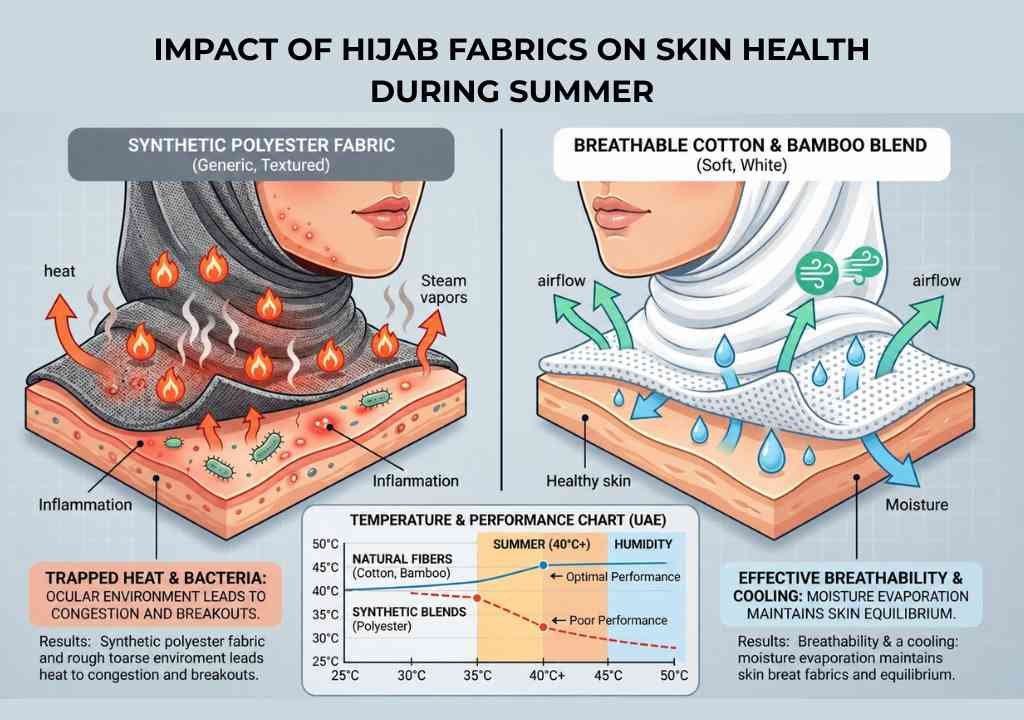
Fabric traps heat. That is just physics. Under your hijab, particularly around the hairline, jaw, and neck, the temperature is measurably higher and the humidity is significantly more elevated than on the rest of your face. This warm, moist microclimate is wonderful for comfort in winter but it is basically a five-star hotel for acne-causing bacteria, specifically Cutibacterium acnes; which thrives in exactly these conditions.
This is why hijabi breakouts tend to cluster along the jaw, chin, and lower cheeks rather than scattering across the forehead or nose like typical hormonal or T-zone acne. The pattern is not random. It is environmental.
There is more friction on your skin than you realise
Every time you put on your hijab, adjust it, or move during the day, fabric is rubbing against your skin. Even soft cotton creates micro-friction over the course of several hours. Over time, this does two things: it weakens the skin barrier in the contact zones, making those areas more reactive and sensitive, and it triggers melanin production as a defence response, which is why so many hijabi women develop dark patches precisely where their scarf sits.
That jawline hyperpigmentation you have been blaming on hormones or old acne marks? There is a good chance friction is either causing it or seriously worsening it. And no amount of brightening serum will fully work if you are reintroducing the irritation every single day.
Your skin gets less sun than you think, and that has consequences
This sounds like a good thing, and in many ways it is. Less UV exposure means slower visible ageing and lower skin cancer risk in covered areas. But it also means the skin under your hijab produces less melanin consistently, while the exposed skin on your face (forehead, nose, and cheeks) is producing more. Over time, this creates a tone mismatch at the boundary zones, particularly noticeable where the hairline meets the forehead.
It also means many hijabi women dramatically underuse SPF, assuming covered skin does not need it. The boundary zones absolutely do, and neglecting them speeds up uneven tone.
Your scalp has its own set of problems
A covered scalp does not get to air out during the day. Sweat and sebum accumulate, the temperature stays elevated, and if you are adding hair oils or leave-ins to the mix, the follicles can become inflamed. This is how folliculitis develops, those small, pus-filled bumps along the hairline that look exactly like forehead acne but are actually infected hair follicles. They do not respond to acne treatments because they are not acne. They need a completely different approach.
According to medical research published in the PMC dermatology literature, among hijabi women surveyed, 31% reported acne as their primary skin concern, 15% reported dryness, and 16% reported scalp issues, yet the vast majority were using general skincare advice not tailored to their specific needs. You deserve better than that.
The Four Rules That Change Everything
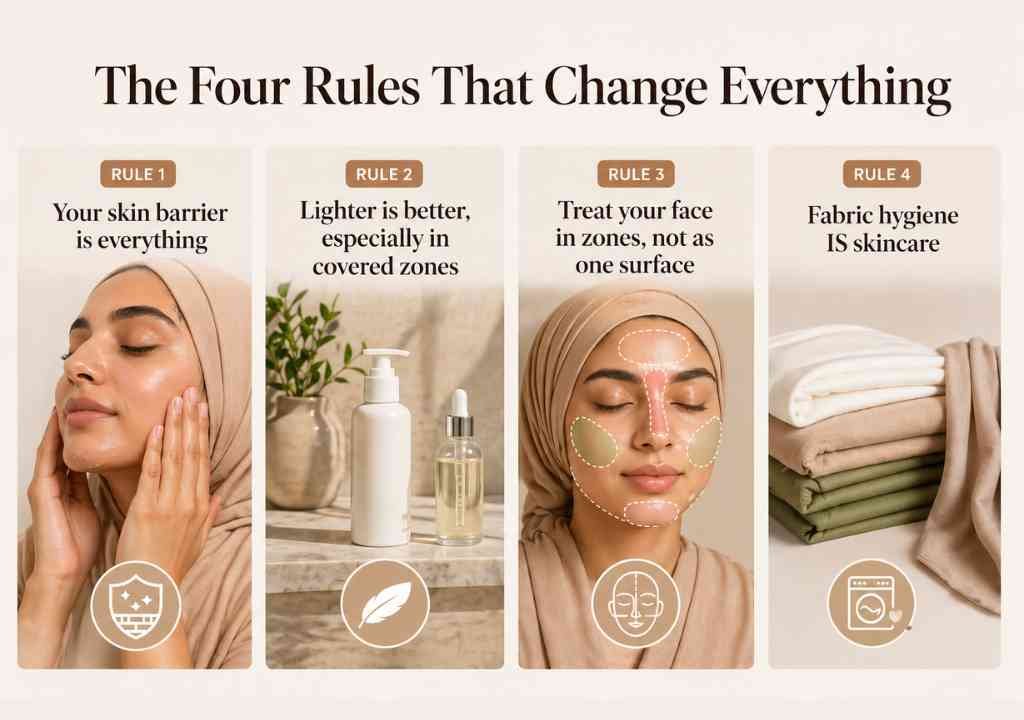
Before we get into the actual step-by-step routine, these are the principles that should be guiding every product decision you make. If something in your current routine contradicts any of these, that is worth revisiting.
Rule 1: Your skin barrier is everything
A healthy, intact skin barrier means your skin holds moisture in, keeps irritants out, and regulates oil production properly. A damaged barrier does the opposite, and covered skin is particularly vulnerable to barrier damage because it is exposed to consistent friction, heat, and occlusion.
So when your skin is congested and oily, the instinct is often to use stronger cleansers or more exfoliation. That instinct is wrong. Stripping the barrier makes oiliness worse (the skin overproduces sebum to compensate), makes sensitivity worse, and slows down healing from existing breakouts. Barrier protection first, always.
Rule 2: Lighter is better, especially in covered zones
Heavy creams, thick balms, and silicone-rich formulas are designed for skin that needs an extra protective layer against the external environment. Your covered skin does not need more occlusion, it already has plenty from the fabric itself. Heavy, oil-based creams can easily trap sebum against the skin, leading to congestion. If you’ve noticed a sudden increase in texture, check out these signs your moisturizer is clogging your pores to see if your current product is the culprit.
On the other hand what it needs is breathable, lightweight hydration that works with the humidity under your hijab rather than adding to it.
This does not mean you cannot use rich products at all. It means save them for uncovered areas and for nighttime, when you are not wearing your hijab.
Rule 3: Treat your face in zones, not as one surface
The skin on your jaw behaves differently from the skin on your nose bridge. The skin along your hairline behaves differently from your cheeks. A one-size routine will always under-serve at least one zone. Once you identify your specific pattern — and most hijabi women have a very consistent one — you can adjust what you apply where.
Rule 4: Fabric hygiene IS skincare
This is the one nobody talks about but it might be the most impactful. If your inner-layer hijab or undercap has been against your skin for two days, it is carrying sebum, sweat, bacteria, and residue from any products you applied. No serum is going to fix skin that is in constant contact with that. Wash inner layers daily or every other day — especially in hot climates. Use a fragrance-free detergent to avoid adding a sensitising variable to your skin.
Quick tip: Natural fabrics, cotton, bamboo, and silk are significantly better for hijabi skin than synthetic blends. Cotton and bamboo breathe and absorb moisture. Silk reduces friction and is gentler on both skin and hair. Avoid polyester undercaps if you struggle with scalp or hairline issues. See my full breakdown of the Best Hijab Fabrics for Summer to stay cool and breakout-free.
Your Morning Skincare Routine for Hijabi Women: Lightweight & Protective
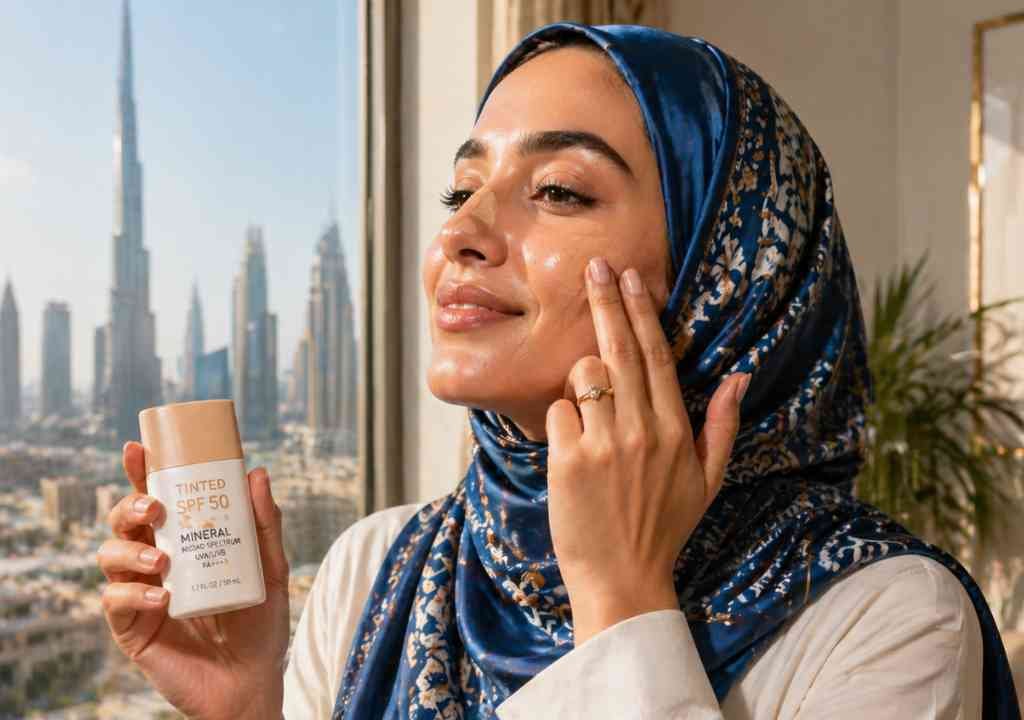
This routine is designed to prepare your skin for a day under the hijab — hydrated, protected, and as congestion-resistant as possible.
Step 1: Low-pH gentle cleanser
Start the morning with a gentle, low-pH cleanser — ideally between pH 4.5 and 5.5. This removes overnight sebum and any residue without disrupting your skin’s protective acid mantle. Avoid anything that foams aggressively or leaves that squeaky-clean feeling — that feeling is your barrier being stripped, not a sign of a good cleanse.
Look for: amino acid cleansers (sodium cocoyl glycinate), gluconolactone-based cleansers, or micellar gel formulas. Avoid: SLS (sodium lauryl sulphate) as a primary ingredient.
Step 2: Hydrating toner or essence
A hydrating toner is not optional in this routine — it is the layer that replenishes water content in the skin before you seal it in. This is the step that keeps skin genuinely hydrated under fabric without the heaviness of a cream.
Look for: glycerin, low molecular weight hyaluronic acid, beta-glucan, or centella asiatica.
Step 3: Niacinamide serum — the non-negotiable
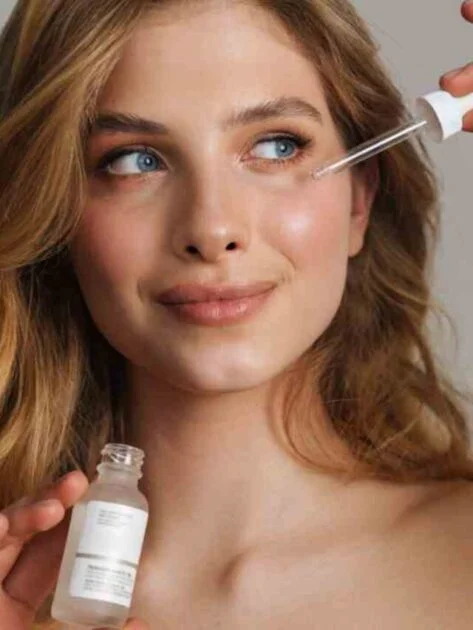
If there is one ingredient that was almost designed for hijabi skin, it is niacinamide. It regulates sebum production (directly addressing the trapped-heat oiliness), reinforces the skin barrier, fades friction-related hyperpigmentation, and quietly reduces inflammation. Use 5-10%. Apply it to the whole face, but it works especially hard on the jaw and hairline zones.
Heads up: if you also want to use Vitamin C, do not layer them together. Use niacinamide in the morning and Vitamin C in the evening, or on alternating days. Some people experience a temporary flush reaction when they are used together.
Step 4: Lightweight, non-comedogenic moisturiser
Choose a gel or gel-cream formula for any area that will be covered by your hijab. Save richer textures for your nose bridge and cheekbones if those areas tend to be drier, or for your evening routine. Not sure which one to pick? We have rounded up the 6 best non-comedogenic moisturizers for extremely oily skin all lightweight, all hijabi-skin friendly.
Look for: ceramides, panthenol, allantoin, squalane. Avoid in covered zones: mineral oil, petrolatum, or heavy silicones as the primary moisturising ingredient.
Step 5: SPF on everything that is exposed
This is non-negotiable on exposed skin, even in winter, even when it is cloudy, even when you are mostly indoors. The boundary zones where covered and uncovered skin meet are where tone mismatches develop, and daily SPF on the exposed side is what keeps that gap from widening.
Use SPF 50 if you can. If you have a medium or dark skin tone, choose a tinted mineral SPF or a chemical sunscreen to avoid white cast — this is a real concern and not just an aesthetic one. White cast often means the sunscreen is sitting on top of your skin rather than being properly absorbed.
Note on makeup: If you wear foundation or concealer over your routine, choose non-comedogenic, oil-free formulas. Your covered skin does not need the extra layer of a heavy base — and a light, well-chosen tinted SPF can often replace foundation entirely.
Your Complete Evening Skincare Routine
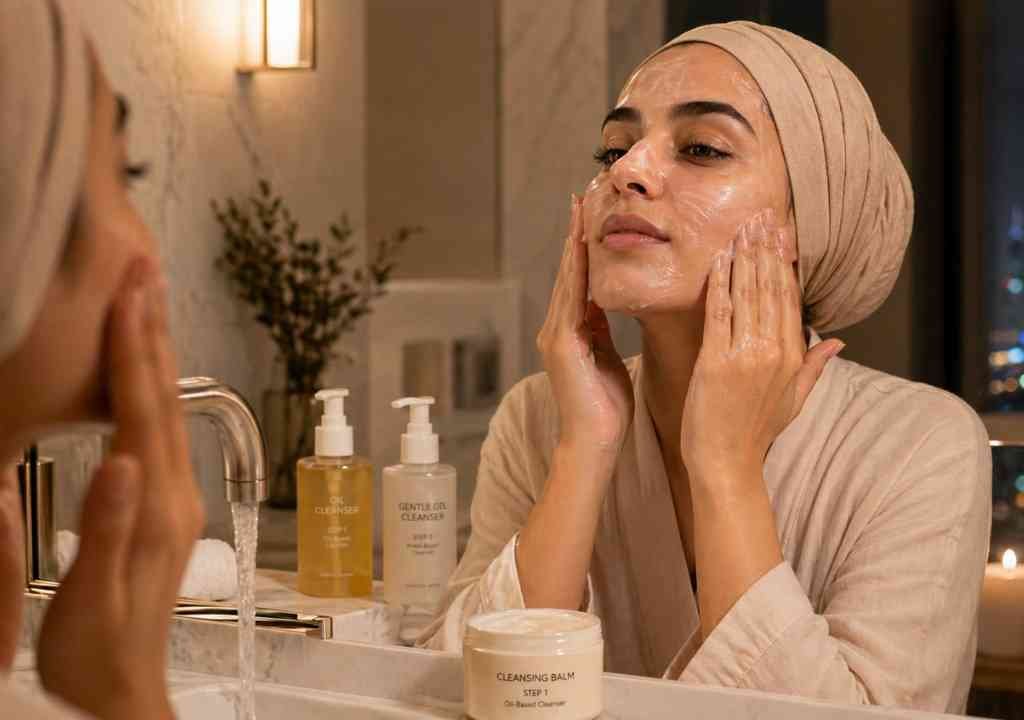
Your evening routine is where the real work happens. This is when your skin repairs itself, and it is your job to give it the best possible conditions to do so.
Step 1: Double cleanse — this one matters
After a full day of SPF, sweat, sebum, and potentially makeup, a single cleanse is not enough. Start with a cleansing oil or cleansing balm to dissolve oil-based impurities (this will not cause breakouts — it dissolves excess sebum, it does not add to it), then follow with your low-pH water-based cleanser.
This is particularly important for hijabi skin because the sebum and bacteria that accumulate during the day need to be fully cleared before you apply your actives. If they are not, you are essentially sealing in the problem.
Step 2: Chemical exfoliant (2-3 times per week, not every day)
Please put down the scrub. Physical exfoliants add friction to skin that already has a friction problem. Chemical exfoliation is far more effective and far gentler when done correctly.
Your options, based on what your skin needs:
- BHA (salicylic acid 1-2%): Best for congested, oily skin and hairline folliculitis. Oil-soluble, so it gets into the pore and the follicle rather than just sitting on the surface.
- PHA (polyhydroxy acid): Best for sensitive skin that reacts to stronger exfoliants. PHAs exfoliate and hydrate at the same time — genuinely the perfect exfoliant for barrier-compromised skin.
- AHA (glycolic or lactic acid): Best for surface-level brightening and tone evening. Use lactic acid if your skin is sensitive; glycolic acid if your skin is more resilient.
Warning: Over-exfoliation is one of the most common causes of reactive, sensitised hijabi skin. If your skin feels tight, looks red, and suddenly seems sensitive to everything, over-exfoliation is the first thing to suspect. Two to three times a week is the maximum, and some skin types do better with once a week.
Step 3: Treatment serum — targeted to your concern
This is where you do the specific work. Choose based on what bothers you most:
- Hyperpigmentation from friction: Alpha arbutin 2% for sensitive skin, or Vitamin C (ascorbic acid 10-20%, or the more stable ascorbyl glucoside) for more resilient skin. Apply directly to the darkened zones.
- Persistent jawline breakouts: Azelaic acid 10-15% is exceptional here — antibacterial, brightening, and anti-inflammatory all in one. It also fades post-acne marks while treating active breakouts.
- Barrier repair priority: Centella asiatica extract, panthenol, or a dedicated ceramide serum. This is for skin that feels reactive, tight, or perpetually irritated.
- Anti-ageing: Retinol (start at 0.025%, work up slowly). Use on alternating nights with exfoliants, never on the same evening. Expect adjustment period — some dryness in the first few weeks is normal.
Step 4: Moisturiser — slightly richer at night
At night, you can afford something a little richer than your daytime formula. Your skin barrier repairs itself during sleep and a slightly more occlusive moisturiser supports that process. That said, if you are acne-prone along the jaw, keep the formula lighter on that zone specifically — even at night.
Barrier hack: If your skin feels particularly reactive or stripped after exfoliation, apply a thin layer of a ceramide-rich product before your moisturiser. This is called the ‘sandwich method’ — ceramides between serum and moisturiser — and it noticeably accelerates barrier repair.
Solving the Most Common Hijabi Skin Problems
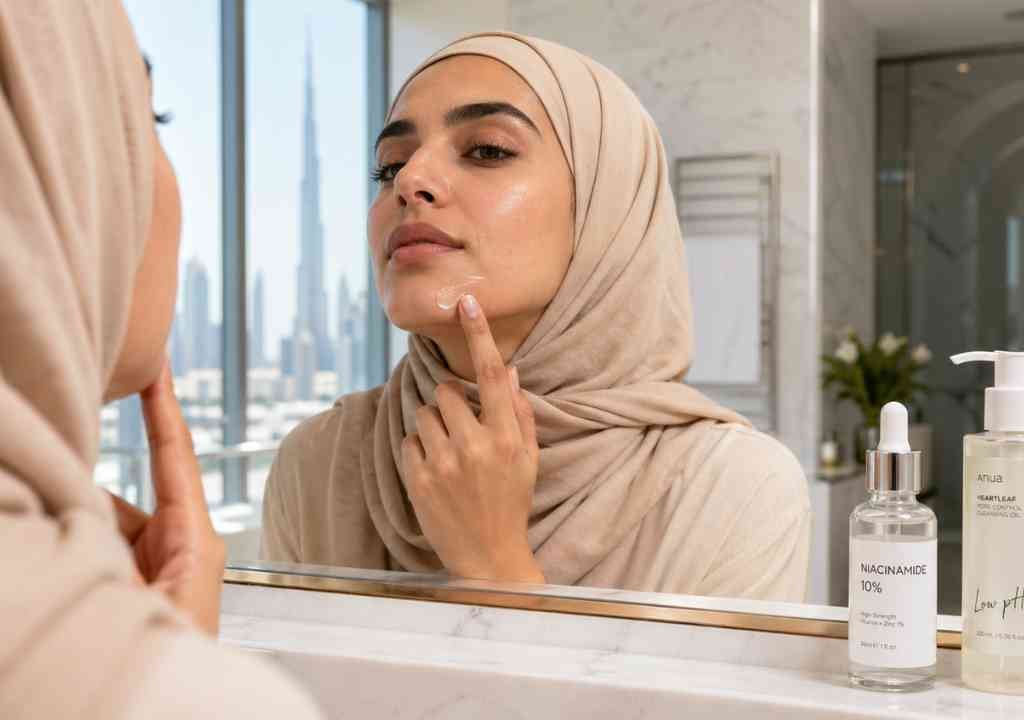
Those Stubborn Jawline Breakouts
Jawline and chin breakouts in hijabi women are almost always a combination of three things: trapped heat creating bacterial overgrowth, friction irritating the skin barrier, and fabric absorbing sebum then re-depositing it. The result is congested, inflamed skin that keeps cycling.
In addition to the routine above:
- Spot treat active breakouts with benzoyl peroxide 2.5% — effective against the specific bacteria involved without the excessive dryness of higher concentrations.
- Wash your undercap daily, full stop.
- If your breakouts trace exactly where the hijab fabric sits, that is a friction signal. Apply a thin barrier product — something with zinc oxide or silicone — along that line before putting on your hijab. It acts like an invisible buffer.
Hairline bumps that are not actually acne
If you have small, uniform bumps running in a neat band along your hairline rather than scattered across your forehead, that is almost certainly folliculitis — inflammation of the hair follicles — rather than standard acne. It requires different treatment and it will not respond to typical acne products.
- Apply a 2% salicylic acid toner along the hairline with a cotton pad — this is oil-soluble and gets into the follicle where the blockage is.
- If the bumps are persistent and do not respond to salicylic acid, consider Malassezia folliculitis, a fungal variant that is common in warm, humid scalp environments. It needs an antifungal treatment (ketoconazole shampoo used as a scalp mask twice a week), not an antibacterial one.
- Keep all hair products — oils, serums, leave-ins — away from the hairline. They are a primary trigger for follicular blockage.
Dark patches along the jaw and cheeks
This friction-induced hyperpigmentation responds well to treatment, but it requires patience and — crucially — you have to address the cause while treating the effect. Using a brightening serum while continuing to create daily mechanical irritation is like mopping the floor with the tap still running.
- Alpha arbutin 2% applied nightly to the affected zones is one of the most effective options for skin that is too sensitive for strong acids.
- Consistent SPF on the neck-to-jaw boundary prevents existing pigmentation from deepening.
- A silicone-based barrier product along the contact line reduces the friction itself. This is the step most people miss.
Dry, flaky patches under the chin and neck
This seems counterintuitive when we have been talking about excess heat and oiliness, but some women — particularly those with naturally drier skin types — experience chronic dryness in covered areas. The mechanism is different: the fabric absorbs moisture from the skin rather than the skin retaining it.
Apply a ceramide-rich moisturiser to the neck and collarbone before putting on your hijab. That layer acts as a protective barrier that keeps moisture in the skin instead of transferring it to the fabric.
Scalp and Hair Care for Covered Hair
Your scalp is skin. It has the same barrier, the same sebaceous glands, and many of the same concerns as your face and it spends significantly more time in an occluded, warm environment. It deserves its own dedicated care.
- Wash frequency: Every two to three days is ideal for most hijabi women, or daily in very hot climates. Allowing sebum and sweat to accumulate for longer than this actively feeds the bacteria and fungi that cause scalp issues.
- Never cover damp hair: This is one of the most common and most damaging habits. Covering wet hair creates an extremely humid, warm environment that accelerates fungal growth, worsens dandruff, and dramatically increases folliculitis risk. Always dry your hair fully before covering.
- Scalp massage: Two minutes of scalp massage during washing improves blood circulation to follicles that do not receive regular airflow. It also helps loosen sebum and product buildup.
- Undercap choice: Cotton undercaps are the most breathable option and best for scalp health. Satin and silk undercaps reduce friction and are better for hair texture and preventing traction-related breakage — choose based on your primary concern.
- Traction alopecia awareness: Tight hijab styles that consistently pull at the hairline can cause gradual hair loss at the temples and front hairline. If you notice thinning in those areas, loosen your pinning style and avoid styles that pull taut for extended periods.
Traction alopecia is often caused by tight styles that consistently pull at the hairline. If you are looking for ways to stay modest without the tension, check out these Hijab Fashion Styles for Modern Muslim Women that prioritize both comfort and a secure fit.
Your Hijabi Skin Ingredient Cheat Sheet
If you want to shortcut the research, bookmark this section. These are the ingredients worth knowing by name.
Always worth having
- Niacinamide (5-10%): Sebum control, barrier support, brightening, anti-inflammatory. The all-rounder.
- Ceramides: Barrier repair. Look for ceramide NP, AP, and EOP together.
- Glycerin: Lightweight humectant. Works in literally every skin type.
- Azelaic acid (10-15%): Antibacterial, brightening, anti-inflammatory. Underrated workhorse for hijabi skin specifically.
- Salicylic acid / BHA (1-2%): Clears congested pores and follicles. Use as exfoliant 2-3x per week.
- Centella asiatica: Calms irritation, supports barrier repair. Great for sensitive, reactive skin.
Effective but use thoughtfully
- Retinol: Excellent long-term for texture, pigmentation, and ageing. Start very low, build slowly, evenings only.
- Vitamin C: Brilliant brightener for exposed skin. Use separately from niacinamide.
- AHAs (glycolic, lactic): Good for surface-level brightening. 2-3x per week max. Choose lactic acid if sensitive.
Avoid in covered zones
- Heavy silicones as primary moisturiser: Trap heat and contribute to congestion under fabric.
- Mineral oil and petrolatum as primary moisturiser: Too occlusive for skin that is already occlusion-covered.
- Alcohol-dominant toners (denat. alcohol high on the list): Damage the barrier and worsen friction sensitivity.
- Physical scrubs on friction-affected areas: Compounds existing mechanical irritation.
- Highly fragranced products: Fragrance is one of the most common sensitisers, and sensitised skin under hijab is harder to calm.
You Do Not Need More Products — You Need the Right Ones
I want to be honest with you: when I first started trying to figure out why my skin kept misbehaving in the same specific zones despite a solid routine, it took a while to connect the dots. The beauty industry just did not — and still largely does not — acknowledge that covered skin has its own needs.
But once you understand what is actually happening under your hijab, everything makes sense. The oiliness, the jawline breakouts, the hairline bumps, the friction marks — none of it is random, and none of it is unfixable. It just requires a framework that was actually designed for you.
Start with the barrier. Build in the lightweight hydration. Add one targeted active at a time. Wash your undercap. And please — stop using that foaming cleanser that squeaks.
Your skin deserves a routine built around your life, not around a bare-faced assumption.
Did this help? If you have a specific concern that I did not cover — or a product combination that has changed your skin — drop it in the comments. I would love to know what is working for you. And if someone you know is struggling with the same questions, share this with her. This is exactly the kind of information that should be getting around.
Frequently Asked Questions
What is the best skincare routine for hijabi women?
A hijabi skincare routine should focus on lightweight, breathable hydration, barrier protection, and targeted actives for covered-skin concerns like sebum regulation and friction hyperpigmentation. The core steps are a low-pH cleanser, hydrating toner, niacinamide serum, lightweight moisturiser, and SPF on exposed areas in the morning; and a double cleanse, chemical exfoliant (2-3x per week), treatment serum, and slightly richer moisturiser in the evening.
Why does my skin break out more when I wear hijab?
Hijab creates a warm, humid microclimate around the jaw, hairline, and neck that accelerates bacterial growth and increases sebum production. Fabric friction also weakens the skin barrier in those zones, making them more prone to congestion and inflammation. Addressing the root causes barrier repair, sebum regulation, fabric hygiene, and breathable fabrics resolves most hijab-related breakouts.
What causes dark patches along the jawline in hijabi women?
Dark patches along the jaw where the hijab sits are most commonly caused by friction-induced hyperpigmentation, repeated rubbing between the fabric and skin triggers melanin production as a protective response. This is different from hormonal hyperpigmentation or post-acne marks and responds to: reducing friction (barrier products along the contact line), brightening actives (alpha arbutin, Vitamin C, azelaic acid), and consistent SPF on the boundary zones.
How often should hijabi women wash their hair?
Most hijabi women benefit from washing hair every two to three days, or daily in hot climates. Covered scalps accumulate sweat and sebum faster than uncovered ones, and allowing that to build up past two to three days significantly increases the risk of scalp folliculitis, dandruff, and seborrheic dermatitis. Always allow hair to dry fully before covering.
Is niacinamide good for hijabi skin?
Niacinamide is arguably the single most useful ingredient in a hijabi skincare routine. It regulates excess sebum production (addressing the oiliness caused by trapped heat), strengthens the skin barrier, fades friction-related hyperpigmentation, and has anti-inflammatory properties. A 5-10% concentration used daily in the morning is a strong foundation for most hijabi skin types.